Why use telemetry and first steps!
Here are a few explanations on reading telemetry for beginners. Not a theoretical lecture, but the basis and some use case based on my own small experience.
If you are just starting out, you do not need 200 channels of data to improve. Tools like AC Viewer are useful for seeing inputs, while MoTeC opens the door to much deeper analysis such as setup, suspension, ride height, aero, tyre behaviour... But that level of detail can also be overwhelming at first. With Telemetrick, the goal is to keep things simple in the beginning, so you can focus on the essentials, build understanding step by step, and only move to more advanced analysis when you are ready. That is also why the MoTeC export can be disabled at first: not because it is unnecessary, but because beginners should not have to face a complex tool before they have learned the basics.
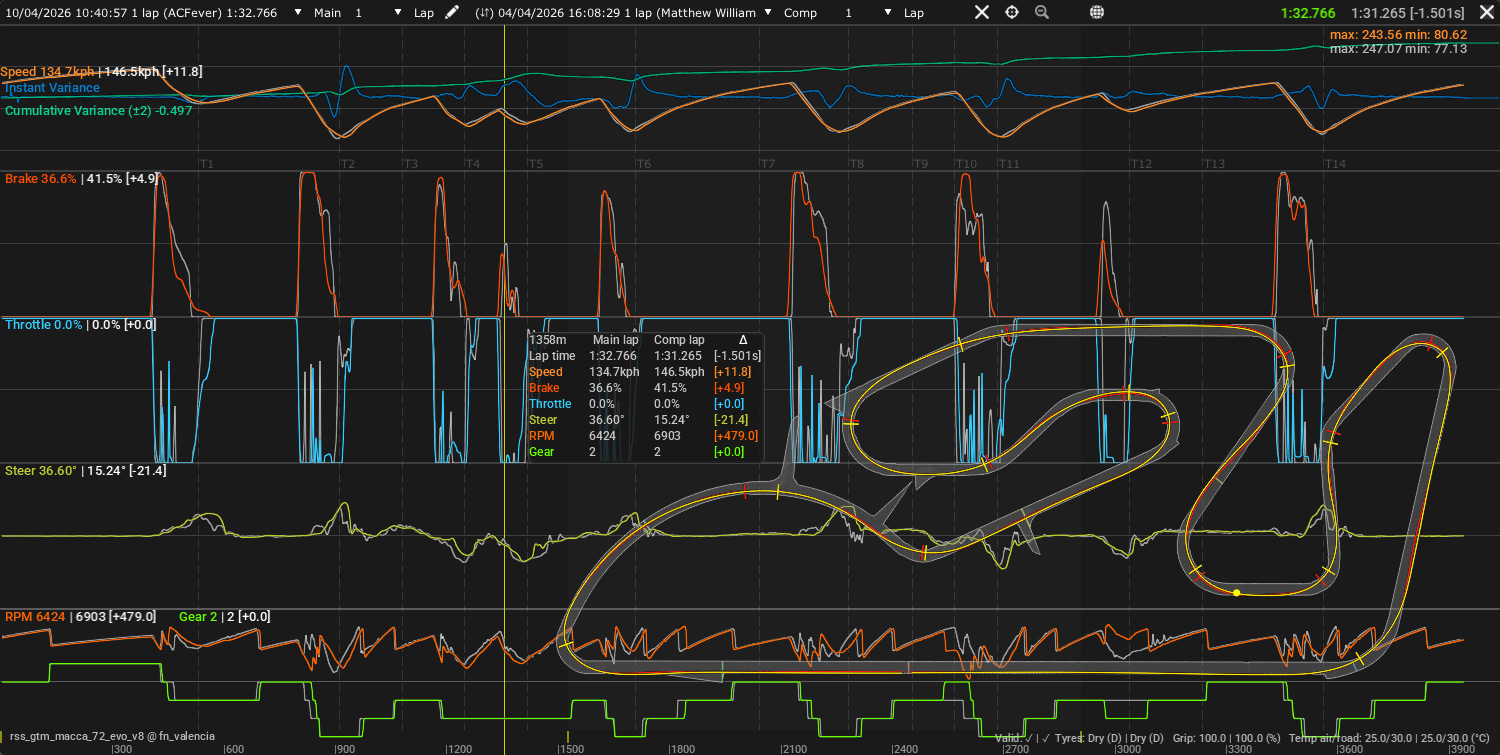
But... what is that?!?
If you are here, that may be what you are asking yourself. And why you should even bother!
I won't talk about chilling on Shuto or no hesi here. That's all right and fun, but indeed you won't need data for that. Telemetry data becomes useful when you begin to chase lap time, have watched many videos on trail braking and other driving techniques, and want to improve but keep asking yourself: how the hell can I go faster?
Telemetry doesn't lie. It's just facts, plain and simple. All your inputs, and your resulting speed. You can go a lot deeper with MoTeC and analyse all tyre data, suspension, etc. to fine-tune your car setup, but we will concentrate here on driver inputs, which show what you are doing.
You may think that you always need a faster driver's telemetry to compare and improve. Yes, it helps a lot, but you can also learn a lot by comparing your own laps, testing some driving techniques, different lines, braking sooner or later, and seeing if it gains or loses time, etc. It can also help show you what you are doing. I remember a fast corner I was taking flat out, only to discover on telemetry that I was unconsciously lifting a tiny bit!! You are not always doing what you think you are doing!
Before learning how to read all this, let me kill a myth: I have tons of Telemetrick MoTeC files from the fastest aliens. A lot of them helped me develop all that stuff, or we just tried together to improve, sharing those files. I can see why, where, and how they are basically 2 seconds faster than me. And you know what? I'm still 2 seconds slower... Comparing yourself to the fastest won't make you magically faster. You will still have to put in the hard work and dedicate time to practice! But you will know what to practice, what you have to learn, and what you have to do better. This doesn't guarantee you will achieve it, but it gives you a clear path to faster lap times!
So, why? Because if you want to improve, you have to train the right way. And for this, you need an objective way to know what to train next!
Everyone starts somewhere. Even the tallest oak was once an acorn.
How to read telemetry
Here is a lap at Valencia, in the RSS McLaren 720S GT3.
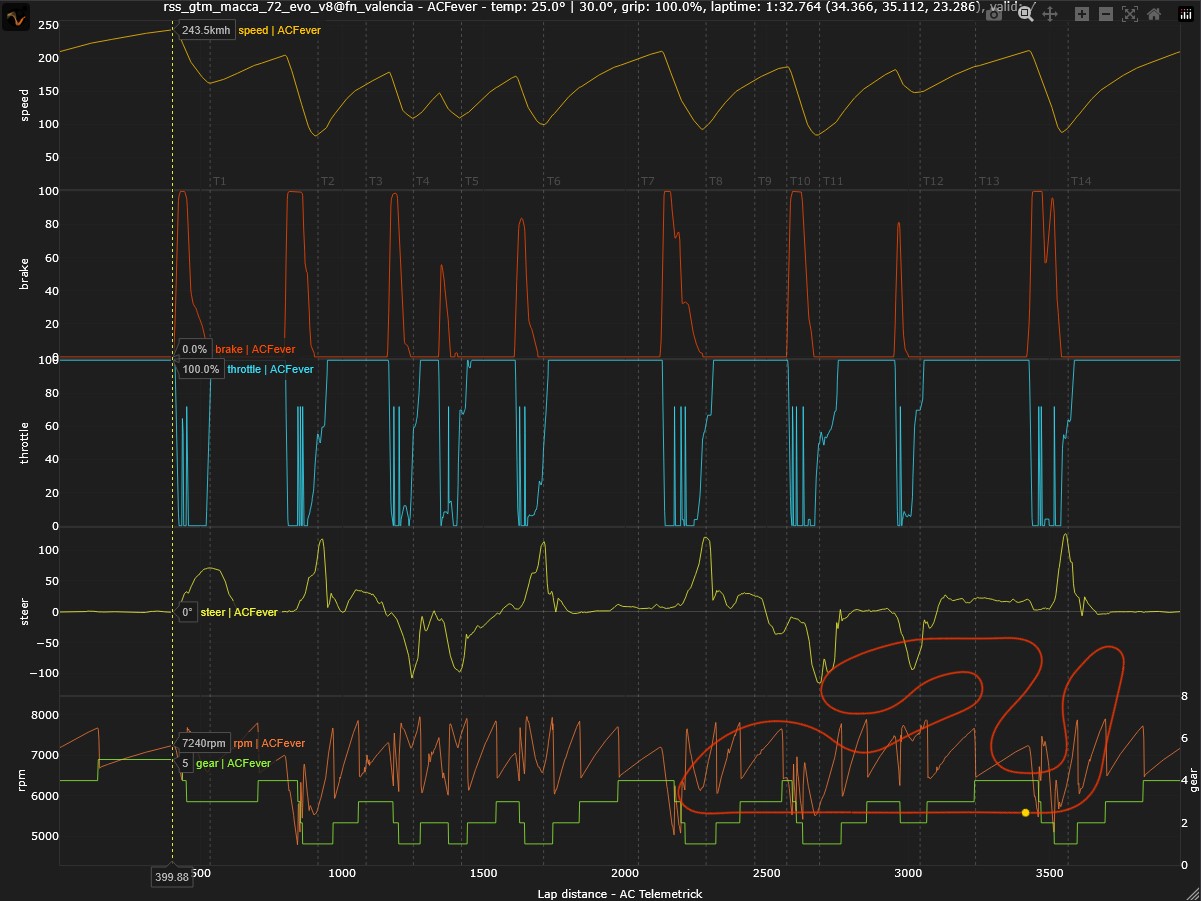
You can open an interactive version here
You can see five rows with, from top to bottom, the curves for:
- Speed in km/h
- Brake application %
- Throttle application %
- Steering angle
- RPM and current gear
On top of that, a track map with your racing line.
The horizontal scale is lap distance. Here, we go from 0 (start of the lap) on the left to 3956m on the right (the end of the lap). You can also see some vertical markers for corners (T1, T2, ...) and, when you move your mouse, a yellow point on the bottom-left track map that shows where you are on the track.
So, while you read from left to right, you are going from the starting line to the end of the lap, seeing at each moment what your speed was, your brake application, etc.
See how speed decrease when you brake, increase when you apply throttle, how fast you downshift while braking. Easy?
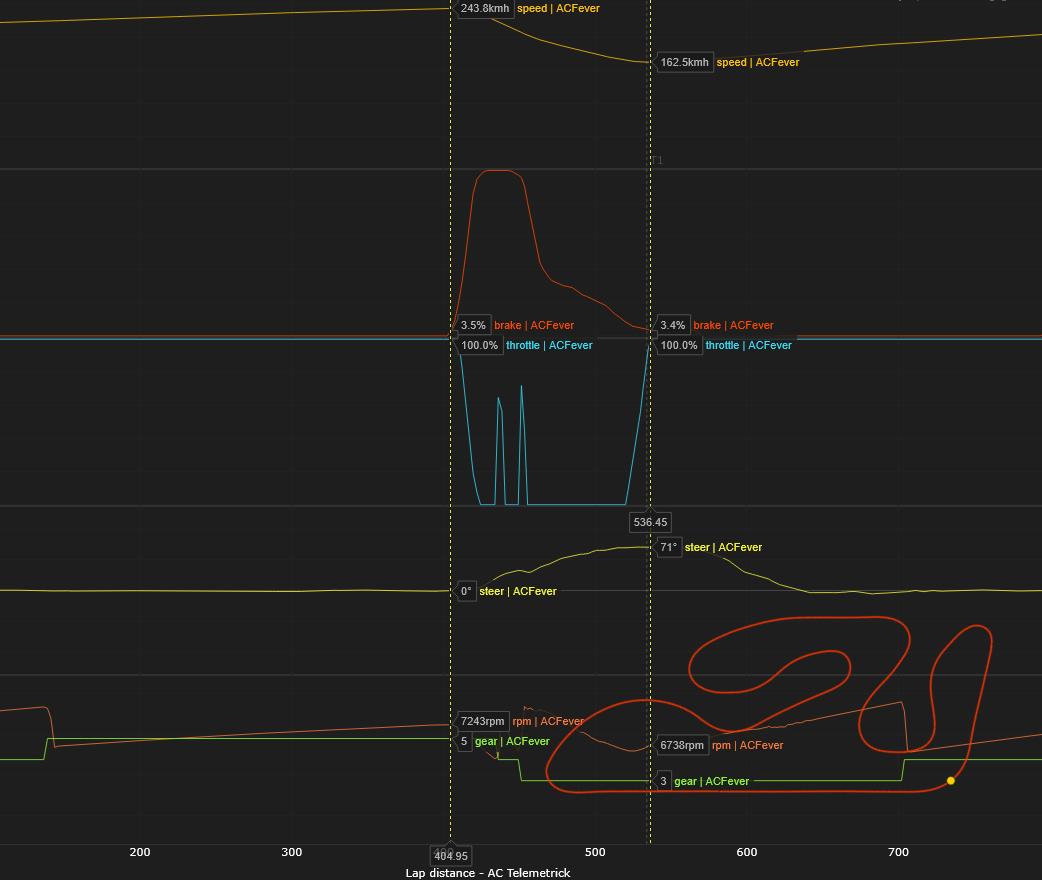
When you zoom in on T1, we can see several things.
- We hit the brake at 405m and stay on it until 536m with a pretty hard initial application followed by a two-step brake release, with speed dropping from 244km/h to 162km/h.
In a GT3 car, the goal here is not big slowing and steering input (hairpin), but strong weight transfer, a smooth release, and using the front load to help the car rotate. Once the car is pointing to the exit, we can apply the throttle quickly.
During the hard braking phase, you can see two throttle spikes. These are not driver inputs, but auto-blips from the downshifts. You can confirm this with the bottom green gear trace.
So, it's not that hard to read, right? You can now see what your maximum brake pressure is relative to speed (for example, T5 is 55% here because we are not that fast), how your brake release and steering angle affect rotation, how your throttle application looks on exit, whether your maximum steering angle comes pretty early before the apex or late (ruining your exit?), etc. You can also check maximum speed relative to aero setup.
One day, I jump into the rig, continue on same car/track combo, feels comfortable, but… constantly 2s slower than my usual mark. What the! I click on that button to have my lap directly in MoTeC and huh! 1% brake everywhere! Back to pedal calibration software, and was back to pace!
Comparing laps
Comparing laps is a key part of improving. Telemetry turns guesswork into clear feedback. Instead of wondering why a lap felt good but wasn't fast, you can see exactly where time was lost: braking too early, turning too sharply, or accelerating too late.
Whether using acViewer or MoTeC, we always use distance (not time) on the x-axis (horizontal) for comparison. Why? Laps take different amounts of time, but Turn X always happens at the same distance. Distance lines up identical track points, making comparisons easy. acViewer is even better/more precise than MoTeC because it uses the projected position on ai spline, where MoTeC use real distance done, which can vary with different racing lines.
We would think that we absolutely need a lap from the fastest driver on the planet to compare to. Well, this is of course nice to have, and if you are chasing the last tenth it can be welcome, but it's not an absolute necessity. You can even learn stuff in a corner from a slower driver; he may be faster in a certain sector or corner!
The basis

Comparing to another lap is pretty straightforward. You load your main lap, then your comparison lap, and this one appear at same place, generally in white. It depends on the software. Here is an online interactive example.
You can see for each trace, here for speed, the main lap in color on top of the compared lap. All at the same distance on the track.
You can also see, on speed trace part, two new blue and green lines (same online and in acViewer). These are instant and cumulative variances. Here, the green line show that step by step, the gap in time with compared lap is growing, up to 1.5s at the end of lap.
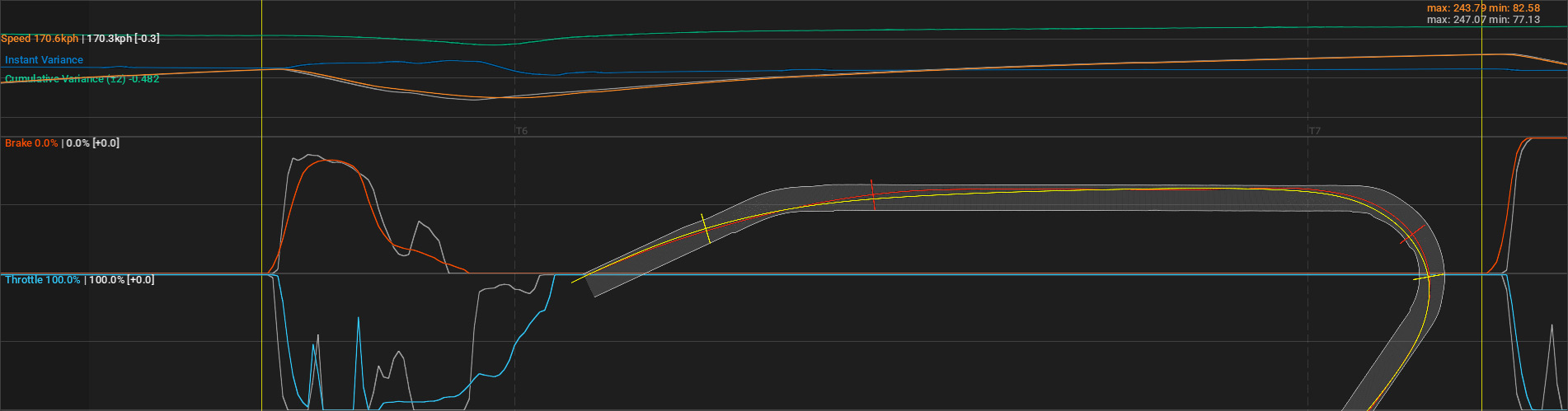
When comparing laps, to see whether you gained or lost time in a corner, one approach is to look at the time difference from the start of braking to 100% throttle. It is indeed a good indication of the corner alone. But, it is omitting why we say slow in, fast out. Because if a driver brakes a bit earlier, or a bit more, he may lose time in the corner itself, but throttle earlier and gain time in the next straight. On the illustration above, I gain 0.5tenths in the corner, but from braking to the next braking, I've lost 1.2tenths! Look at that white throttle trace!
Comparing with yourself
I've learned a lot myself by comparing my own laps before comparing them to others in two different scenarios: actually learning how to drive fast overall, or learning a new track.
When I began sim racing three years ago, I was surprised by how much later faster drivers could brake. So, I concentrated on braking later and later! Because the later you brake, the more time you spend at higher speed, right? But by comparing my laps, it took me time to understand that yes, braking later is faster, but only until it compromises your exit. Then you learn that the braking point is not the last point where you can brake and still make the corner; it's the last point that still allows you to get the best possible exit. And this, I learned just by comparing my own laps.
A good approach is to take a car/track combo you know well (save a CM preset to have repeatable conditions), log a fast lap, and then practice with some driving techniques in mind. Try braking a bit earlier and applying the throttle as soon as possible, try different racing lines, try different ways of releasing the brake and steering input to get the rotation you want in this or that corner, etc. And each time, compare that lap to your previous reference lap. You will learn a lot just by doing this!
Always practice with one thing in mind to work on. Compare to your own reference lap.
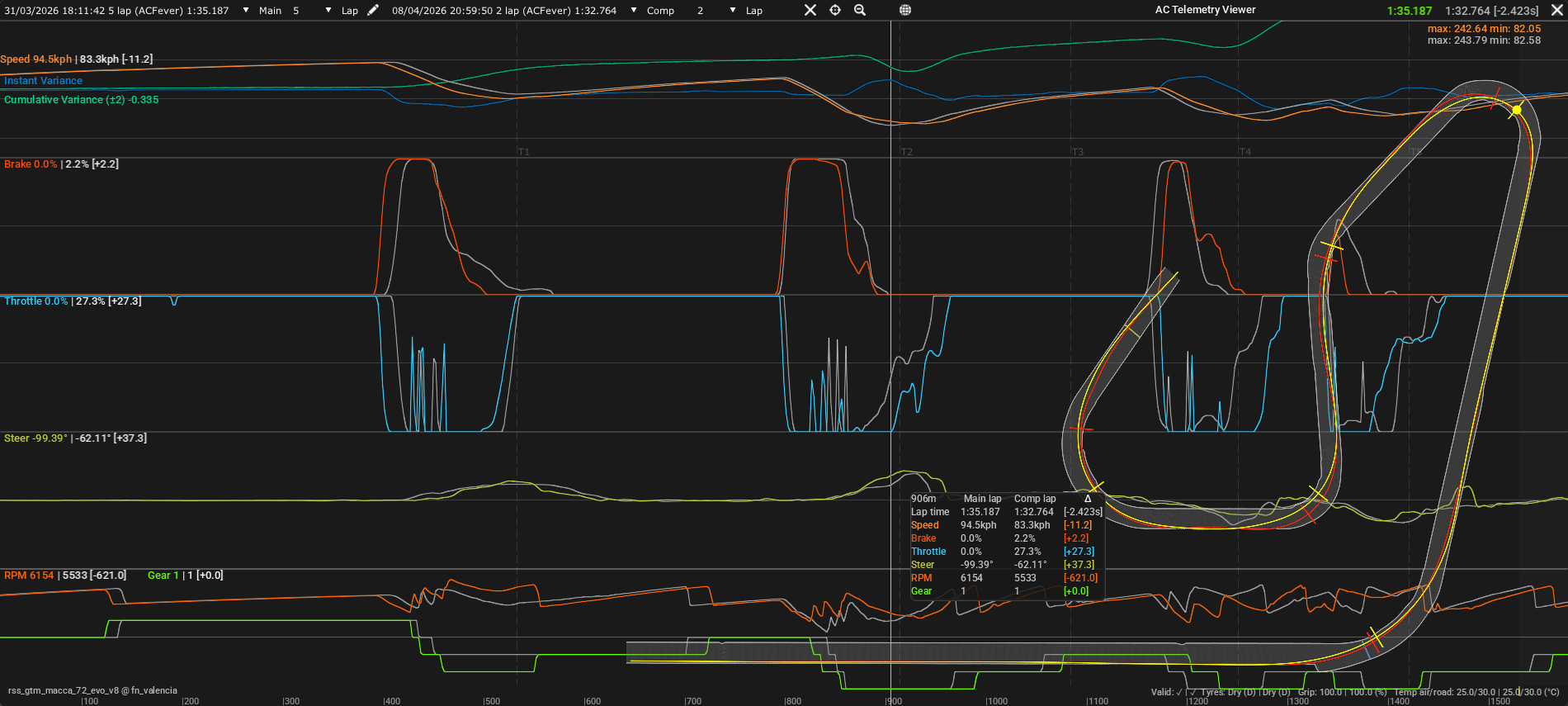
Look at this one, one of my first stints on this combo, versus (white) my fastest one.
- T1, I brake too early, being on throttle at the same place: 4tenths!
- T2, I don't brake enough, want to keep too much speed (which I do), turn in too early giving rotation too late (look at the racing line), being later on throttle: 3tenths!
- T4, Braking too late, too much speed, can't keep a good line, late throttle: 4tenths!
2.4s total difference.
That's the kind of stuff that you can find yourself, alone, just trying better braking, better lines, based on your own feeling while driving, and objectively reviewing with telemetry to always adjust in the right direction!
Comparing with other drivers.
Comparing to faster drivers will show you all the stuff you didn't see with your own laps. Or, on a particular track, a corner that you didn't though was possible like this.
Never lose sight of the fact that comparing yourself to the best can be brutal. But bear in mind that you might have a family, a job, friends, and that you haven’t been training for 8 hours a day for the last 10 years ? And on a circuit with 20 corners, 2 seconds per lap works out at 1tenths per corner – not that far off!
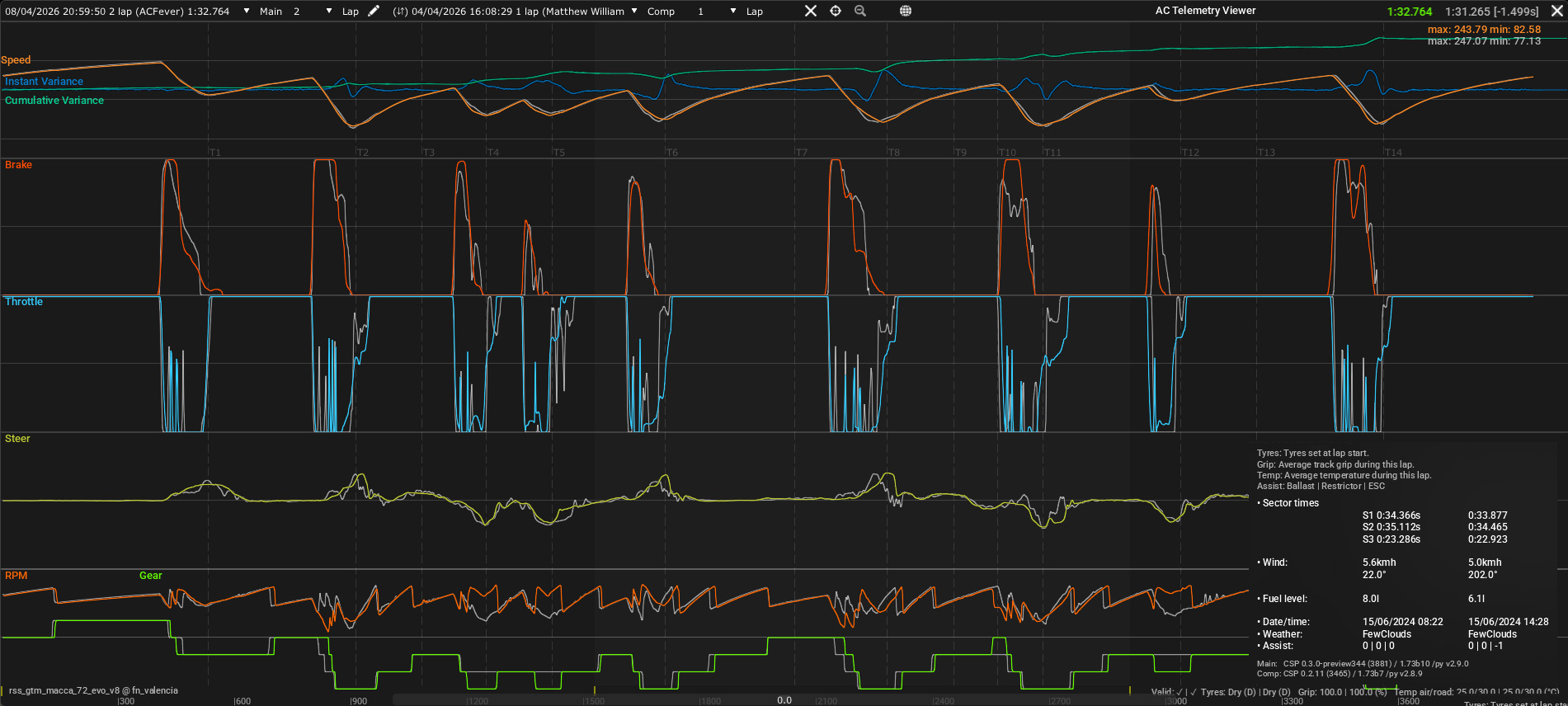
Here is me (again!) against a fast driver, 1.5s faster. This was on a Telemetrick Challenge, so exact same track conditions.
First thing to look at is the (green) cumulative variance and speed trace. Here you can see that there isn't a specific corner where I lose a lot; this is more a constant, bit by bit losing along the lap. So, next question is ... ? Why!?
Look at the other traces. Apart from T11, braking is pretty similar. The main difference is the throttle application. He is at 100% throttle just earlier everywhere, and variance shows that (T14 aside, I brake too early here), I lose indeed mainly on exit and following straights. Now, look at steering angle, very informative also. T1 is very different but no gain or loss here, but at T2, T6, T8, T11 you can see that my max steering angle is a lot later, and sometimes more! That's why I can't be as soon on throttle. But why?? Because I don't rotate the car enough, soon enough, to be ready earlier for exit! That's one of my main skill issues, which I have been working on lately.
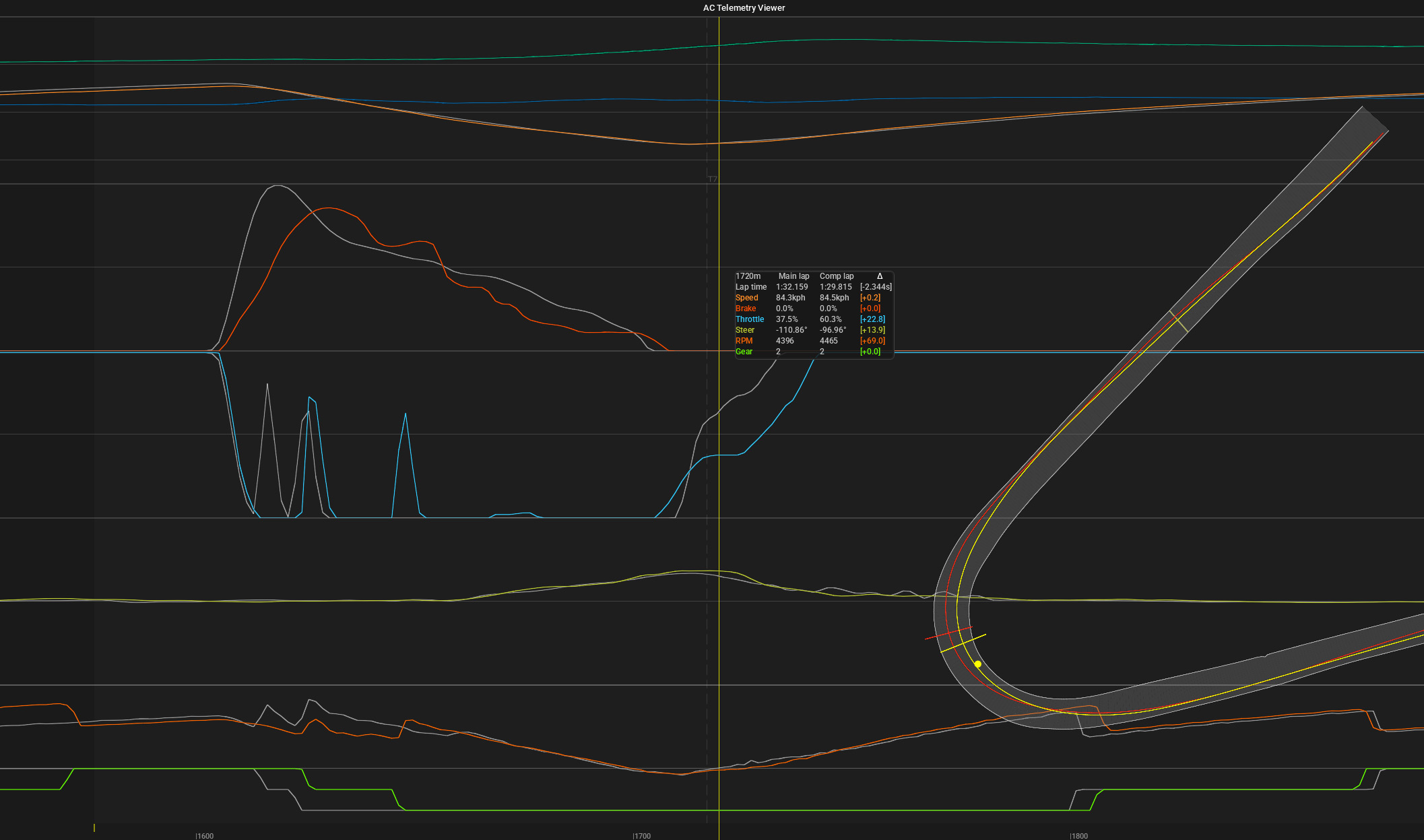
Now have a look at this interesting corner. Just before braking I'm 0.48s behind. At 100% throttle, I'm 0.72s behind. At first, speed is really similar on entry, minimum apex speed is the same, and I'm even a bit faster after exit (keep an eye on bottom distance scale). I brake less aggressively but still pretty similarly. So what happens here? We are talking about 0.24s in 140m!
Look at racing lines! Yes, we are taking the corner at roughly the same speed, but his racing line is a lot shorter! time = distance / speed, and the slower a corner, the more time you spend in it, the more important it is to keep a short line. Of course, this can vary with car, if power limited and such (here, VRC 499P), but it's still valid.
Finnally:
Always try to compare similar track conditions. Being air temperature (more with downforce car), track temperature and grip %, always keep them in mind. Fuel load can also have a big impact. All these data is shown in acViewer and MoTeC!
Car setup
Car setup is a different topic, but requires the same reading and comparing. Once you get a pretty fast lap on a track, getting the track flow and knowing your car, you can look at tyre temperatures for pressure and camber. Look at ride height to get as low as possible, keeping a good rake angle depending on suspension and heave settings etc. And mainly, ask yourself what in the current car behavior prevents you from going faster, and see why in analysis and on which setting (suspension, ARBs, wheel rates, ...) you should act.
There are literally entire books on this, and this is not the topic in this telemetry introducton.
Make it your own path to improvement, without ever losing sight of the most important thing that will keep you from wanting to give up: keep it fun! Telemetry Exchange makes this community-driven: share telemetry files, get feedback, grow together. It's how aliens refine 1:10 laps, and how you'll get there too.